Computational biologist and inventor working where cancer genomics meets clinical prediction. At NYU Langone he invented a genomic copy-number metastasis signature for prostate cancer, at the Albert Einstein College of Medicine extending it into a pan-cancer, clinically validated test. Today he builds panMPS, an AI-built precision-oncology platform, and PearlQuant Studio, which turns the science into films. Three issued U.S. patents · Ph.D., Computational Biology, New York University, 2009.

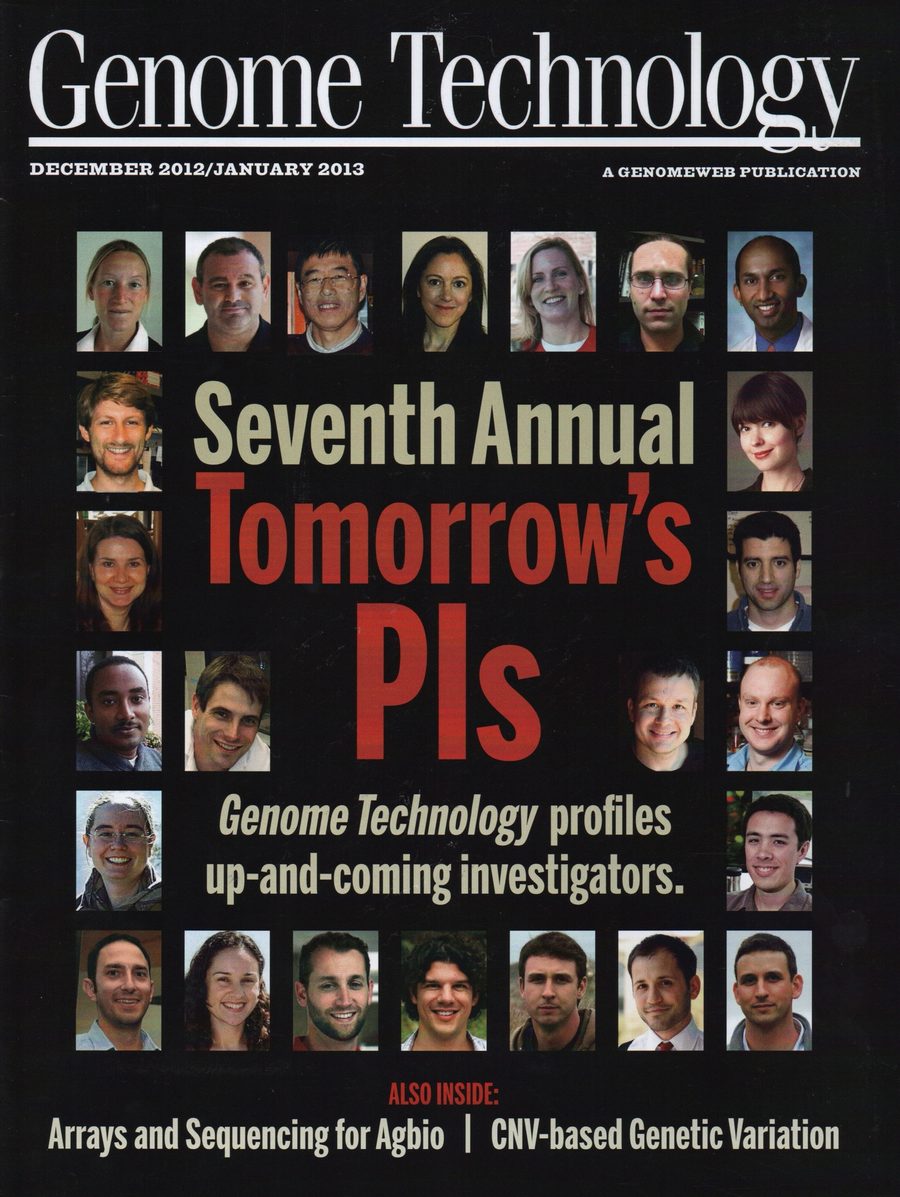
Genome Technology (a GenomeWeb publication), December 2012/January 2013 · profile by Justin Petrone · recommended by Harry Ostrer, Albert Einstein College of Medicine
Named to the magazine's seventh annual class of up-and-coming investigators — two dozen researchers profiled as the field's leaders of tomorrow — for a genomic copy-number-alteration model that predicts, as early as possible, whether a localized prostate cancer will go on to metastasize. The methods paper, in the Journal of Probability and Statistics, capped a decade of work and was written as the foundation for a clinical test.
The goal he set out in the profile was concrete: an FDA-approved kit that predicts prostate-cancer metastasis and spares men unnecessary surgery and radiation. “The finish line is pretty clear,” he told the magazine, describing the road to it — FDA guidance on the kit, collaborators and software developers, and new cohorts across institutions.
The profile traced his path from biomedical engineering to a bench post at Rockefeller University developing microarray assays, and from there into computational biology — pulled in, as he put it, by the data those assays produced, and carrying the assay developer's habits of efficiency and optimization into code and quantitative analysis. The original motivation was personal: cancer in his own family. He credited the breadth of projects in Harry Ostrer's NYU lab with teaching him how to run large-scale work and integrate many kinds of information toward a tangible clinical product; Ostrer had since moved to Einstein, where the two were working on the path to clinical use. Asked about the Nobel, he said the prize he would want is the one for peace.

| Ph.D., Computational Biology | New York University | 2009 |
| M.S., Molecular Biology | New York University | 1999 |
| B.S., Biomedical Engineering | New York Institute of Technology | 1996 |
| 2020 – present | Consultant, self-employed, Boca Raton, Florida |
| 2020 – 2023 | Chief Scientific Officer, Hursana, LLC, White Plains, New York |
| 2020 – 2022 | Consultant, Cancer Center, Albert Einstein College of Medicine |
| 2017 – 2020 | Associate, Cancer Center, Department of Radiology, Albert Einstein College of Medicine |
| 2011 – 2017 | Instructor, Department of Pathology, Albert Einstein College of Medicine |
| 2002 – 2011 | Research Scientist, NYU Langone School of Medicine |
| 1999 – 2002 | Research Scientist, The Rockefeller University |
| 2013 | Genome Technology · Seventh Annual “Tomorrow's PIs” (GenomeWeb) |
For more than 15 years I have developed clinical-grade genomic diagnostic algorithms end to end — design, analytical validation, and regulatory readiness in oncology. My work centers on one question: whether tumor genomic copy-number alteration (CNA) patterns can predict metastatic potential across cancers.
At NYU Langone and then at Albert Einstein College of Medicine I developed a copy-number signature of metastatic potential in prostate cancer (Pearlman et al., 2012), extended it into a pan-cancer predictor of metastasis (Pearlman et al., 2018) and co-developed a next-generation sequencing assay for clinical specimens (Fofanov et al., 2019). This body of work is patented and published.
My validation philosophy is conservative: performance standards set against real-world outcomes rather than optimistic benchmarks, mandatory replication in independent cohorts, and a clear separation between what a test measures and what it has earned the right to claim. More recently, as an independent consultant, I have re-engineered the signature platform for the multimodal-data era, harmonizing genomic copy number alterations across whole-exome and whole-genome sequencing platforms. In preliminary, unpublished analyses of public data sets I have also harmonized copy number with RNA-seq gene expression from the same tumors and begun examining copy-number signal in ctDNA/cfDNA — an early step toward liquid-biopsy applications.
I maintain an active collaboration with the Department of Pathology at Albert Einstein College of Medicine, where I was an Instructor from 2011 to 2017; I was then an Associate in the Cancer Center and Department of Radiology (2017–2020) and a Consultant to the Cancer Center (2020–2022). I currently mentor bioinformatics students from Brown University and CUNY. From 2020 to 2023 I was Chief Scientific Officer of Hursana, LLC, where I led real-world-data programs, including a pharmacoepidemiology study of cannabis use and opioid prescribing in New York primary-care practices; Hursana holds no rights to the panMPS signature or assay.
Pearlman A, et al. Genes & Cancer, 2018. PMID 29725504. Open access.
Open access · View PDF ▸Pearlman A, et al. PLOS ONE, 2019. PMID 30763339. Open access.
Open access · View PDF ▸Pearlman A, et al. J Probability & Statistics, 2012. PMID 25419216. Open access.
Open access · View PDF ▸Fofanov VY, Upadhyay K, Pearlman A, et al. J Molecular Diagnostics, 2019. PMID 30553750.
View on PubMed ▸Rose AE, Poliseno L, Wang J, Clark M, Pearlman A, et al. Cancer Research, 2011. PMCID PMC3070783.
View on PubMed Central ▸Loke J, Pearlman A, Upadhyay K, Tesfa L, Shao Y, Ostrer H. Human Molecular Genetics, 2015. PMID 25652403.
View on PubMed ▸Syeda MM, Upadhyay K, Loke J, Pearlman A, Klugman S, Shao Y, Ostrer H. Genetics in Medicine, 2017. PMID 28301456.
View on PubMed ▸Atzmon G, Hao L, Pe'er I, Velez C, Pearlman A, et al. American Journal of Human Genetics, 2010. PMCID PMC3032072.
View on PubMed Central ▸Campbell CL, Palamara PF, Dubrovsky M, et al. (incl. Pearlman A). PNAS, 2012. PMCID PMC3427049.
View on PubMed Central ▸Zou Y, Fineberg S, Pearlman A, Feinman RD, Fine EJ. PLOS ONE, 2020. PMCID PMC7714189.
View on PubMed Central ▸US Patent 10,519,505 (issued).
View PDF ▸US Patent 10,718,774 (issued).
View patent ▸US Patent 12,227,809 (issued Feb. 18, 2025).
View PDF ▸